Battery price per kWh: check a quote three ways
The total on a battery quote tells you little until you divide it. Divide by nominal kWh to compare with the official figures, by usable kWh to compare batteries, and by warranted energy to compare what the warranty covers.
Quick answer
A home battery's price per nominal kWh was a median of £1,300 under 6 kWh, £890 for 6 to 11 kWh and £630 for 11 kWh and over in 2025/26 (DESNZ), fitted, at the 0% VAT rate that runs until 31 March 2027. Divide your quote by its nominal kWh to compare with those figures; divide by usable kWh to compare batteries with each other.
Quote checker
Enter the total on your quote and the nominal size. Add the usable size from the specification sheet if you have it. The result stays on your screen: nothing is sent anywhere.
£990 per nominal kWh
That is 11% above DESNZ's 2025/26 median of £890 for batteries in the 6 to 11 kWh band (mean £870).
The example figures are ours, for illustration. Enter your own quote above.
Nominal kWh: the official basis
Every price DESNZ publishes is per kWh of nominal storage capacity, the rated energy MCS records for each battery. That is the label size: "5 kWh", "10 kWh", "13.5 kWh". To compare a quote with the official figures, divide by the same thing.
| Size band | Median 2025/26 | Mean 2025/26 | Median 2024/25 | Batteries in 2025/26 sample | Share of sample* | Average size* |
|---|---|---|---|---|---|---|
| Under 6 kWh 1 to 5.99 kWh | £1,300 | £1,280 | £1,080 | 16,270 | 37.9% | 5.1 kWh |
| 6 to 11 kWh 6 to 10.99 kWh | £890 | £870 | £910 | 14,457 | 33.7% | 9.8 kWh |
| 11 kWh and over 11 to 29.99 kWh | £630 | £670 | £590 | 12,176 | 28.4% | 15.5 kWh |
The median is the middle installation in each band; the mean is the average, which a few very cheap or very dear installs can pull either way. DESNZ removes the extremes before calculating either: batteries under 1 kWh or over 30 kWh, and costs below £100 or above £5,000 per unit of capacity. A quote that sits a little above the median is normal. One far above it is a reason to ask for the lines, not a verdict.
Usable kWh: what you can actually draw out
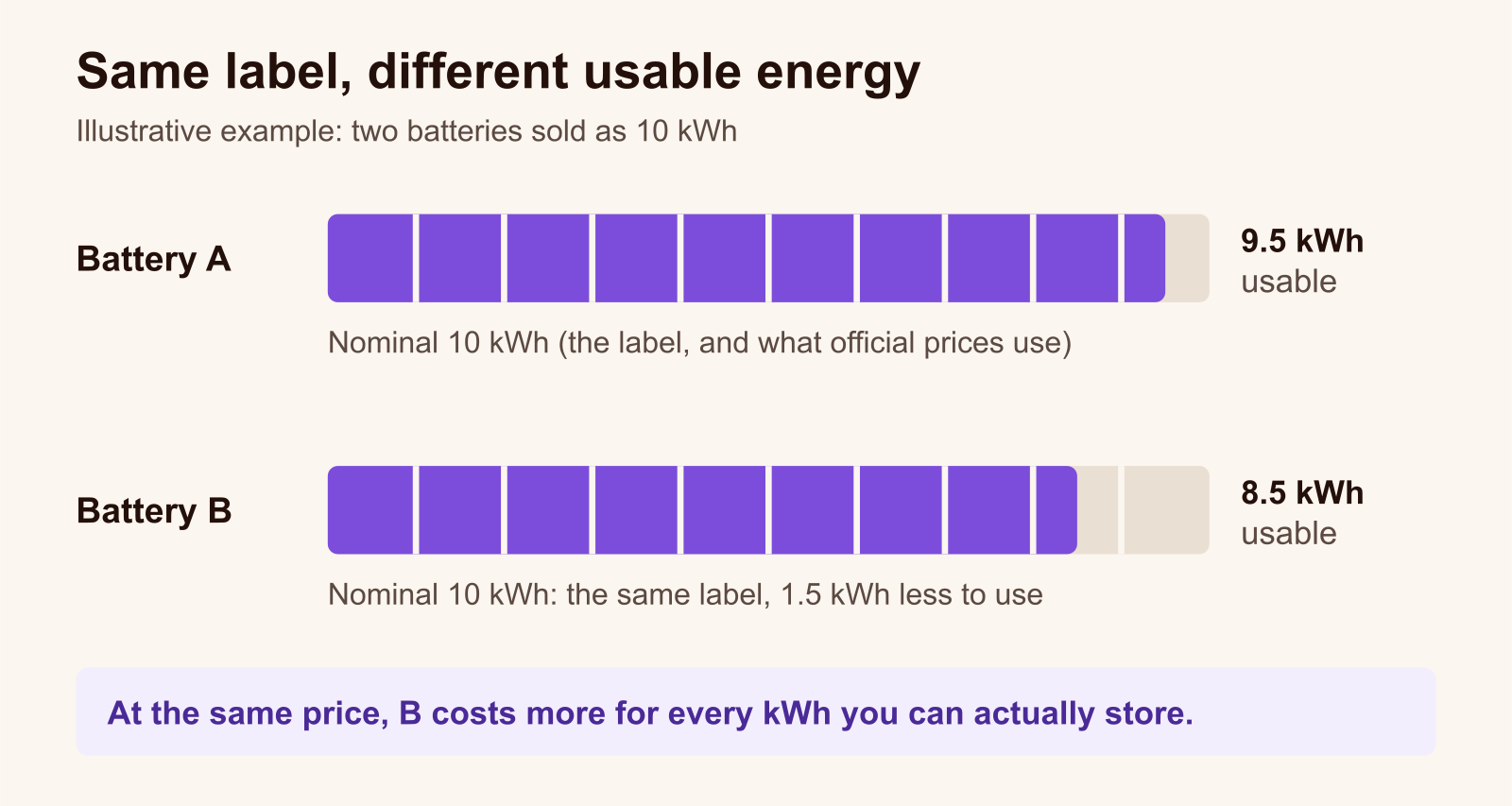
Batteries keep part of their capacity in reserve to protect the cells, so usable capacity is usually a little below nominal. Specification sheets normally give both. The difference is the most common reason two quotes for "the same size" are not the same deal: a cheaper battery that lets you use less of its label can cost more for every kWh you store.
Warranted kWh: what the warranty promises
Most battery warranties promise two things: a number of years, and a total amount of energy the battery may put through before the warranty ends (sometimes written as a number of cycles instead). Which? says battery systems often come with a 10-year warranty. Divide the price by the warranted energy and you get a price per warranted kWh, which lets you compare what the warranty actually covers.
If the warranty gives cycles instead of energy, multiply usable kWh by the cycles for an approximate figure. That ignores the slow loss of capacity as a battery ages, so treat it as the most generous reading.
Illustrative example: two 10 kWh quotes
These figures are invented to show the method; they are not real products or prices.
| Quote A | Quote B | |
|---|---|---|
| Price, fitted, 0% VAT (until 31 March 2027) | £8,800 | £8,400 |
| Nominal / usable kWh | 10 / 9.5 | 10 / 8.5 |
| Warranted energy | 30 MWh | 20 MWh |
| Per nominal kWh | £880 | £840 |
| Per usable kWh | £926 | £988 |
| Per warranted kWh | 29p | 42p |
Quote B is £400 cheaper and looks better per nominal kWh. Per usable kWh it is dearer, and per warranted kWh it costs 42p against 29p. Which matters more depends on how you will use the battery, but you can only see the trade-off once the price is divided three ways. A price per warranted kWh is a purchase cost spread over the warranty, not what your electricity will cost.
Four ways a per-kWh figure gets distorted
- Panels bundled in. DESNZ's battery figures leave panels out. Divide a solar-plus-battery total by the battery's kWh and the result looks wildly high; split the quote first, as solar and battery prices explains.
- VAT at a different rate. The official medians were recorded at 0% VAT, the rate until 31 March 2027. A quote invoiced from 1 April 2027 carries 5%, so take it off before comparing; the checker does this when you choose the later date.
- Usable kWh on the quote. Some quotes lead with usable capacity. Dividing by it against a nominal median makes the quote look dearer than it is. Check which figure the quote uses.
- Extras that DESNZ leaves out. Extended warranties and building work beyond fitting and connection are not in the official figures. If they are in your total, take them out before comparing, or compare them separately.
After the sums: what to ask
If your quote is above the median, ask for the extras to be itemised: the guide to what adds to a battery quote lists them with the rule each comes from. If it is below, ask what it leaves out. Check the installer on the MCS register for battery storage, and ask who honours the warranty if the installer stops trading.
And mind the invoice date. A quote invoiced on or after 1 April 2027 carries 5% VAT; the checker takes it off before comparing, because the official medians were recorded at 0%. The VAT page explains the step.
Price per kWh questions
What is a good price per kWh for a home battery?
There is no "good" figure, only a benchmark. DESNZ's 2025/26 medians are £1,300 per nominal kWh under 6 kWh, £890 for 6 to 11 kWh and £630 for 11 kWh and over. Half of recorded installs cost more and half less; a quote above the median should come itemised.
Should I compare quotes on nominal or usable kWh?
Use nominal kWh to compare with the official figures, because that is what DESNZ prices. Use usable kWh to compare two quotes with each other, because it is the energy you can actually draw out.
Is the price per warranted kWh the cost of my electricity?
No. It is what each kWh the warranty covers costs you in the purchase price. It ignores your tariff, losses in charging and discharging, and any capacity fade, so it is a way to compare quotes, not a saving or a running cost.
Sources (page last reviewed 3 November 2026)
- DESNZ: MCS certified domestic battery installation statistics (April 2024 to March 2026 workbook, published 28 May 2026), checked 3 November 2026.
- HMRC: VAT on energy-saving materials and heating equipment (Notice 708/6), sections 2.1, 2.3 and 2.19, checked 3 November 2026.
- Which?: solar panel battery storage (secondary source, page updated 30 October 2026), checked 3 November 2026.
- MCS: find an installer (the public register), checked 3 November 2026.
Want quotes to hold up against these figures?
Tell us the battery size you are pricing and your postcode. Your enquiry reaches SEO-DONS LTD, the company that publishes this price guide, and we reply by email. Sending it costs you nothing and commits you to nothing.
What happens next
- SEO-DONS LTD, the publisher of this price guide, receives your enquiry.
- We read what you sent and answer by email.
- You decide what, if anything, happens next.