G98 or G99: the network step in a home battery quote
A home battery connects to the same network as everyone else's, so the local network operator has to know about it. Which form is used, and when, can decide how soon a battery goes in.
Quick answer
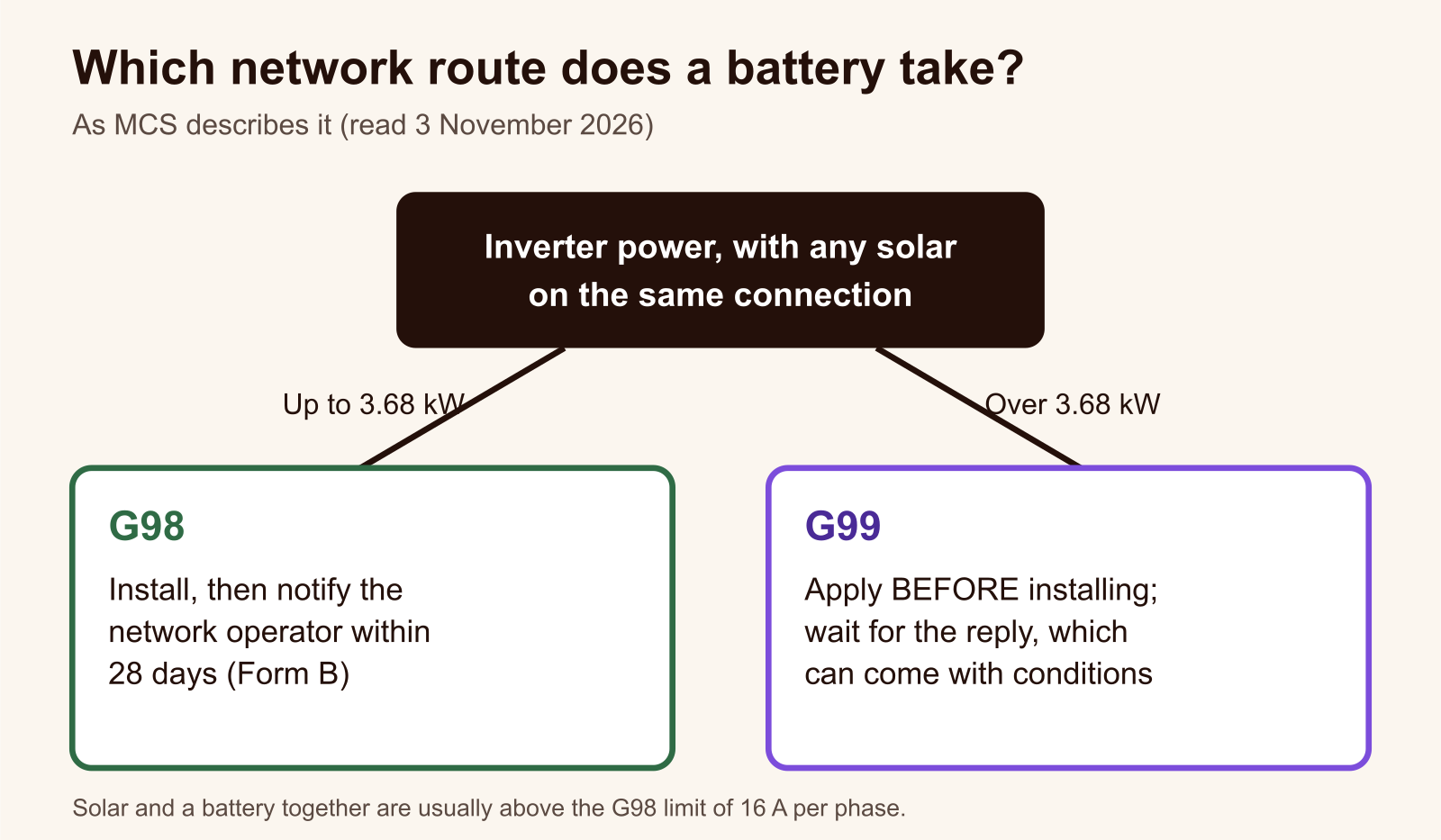
Every home battery must be notified to the local network operator. MCS says a system up to 16 A per phase (about 3.68 kW on a single-phase home) can be notified under G98 within 28 days of installation, while storage over 3.68 kW needs a G99 application before installation. Solar and a battery together usually fall under G99.
Why the network operator needs to know
Your home's electricity comes through a distribution network run by a regional operator. When a battery charges from the grid, the operator sees it as demand; when it sends power back, it sees it as generation. Too much unplanned generation on one street can push voltages out of limits, so the industry has two engineering recommendations, known as G98 and G99, that set how small and larger systems are notified or approved.
MCS is blunt about it in its guidance to installers: the relevant network operator must be told about electricity-generating installations in every case, battery storage included. In practice the installer handles the forms. What you need to know is which route your system takes, because it affects the timetable.
| G98 | G99 | |
|---|---|---|
| Size of system | Up to and including 16 A per phase, about 3.68 kW on a single-phase supply | Over 3.68 kW of storage, or a combined system above the G98 limit |
| When | Notify within 28 days of installation | Apply before installation |
| Form | G98 Form B for battery storage | G99 Form A1.1, or the fast-track integrated form |
| Effect on a quote | Little: paperwork after the work | Time for the operator's reply; the answer can come with conditions |
National Grid Electricity Distribution, one of the operators, puts the G98 route in its own words: for small-scale generation or storage under G98, notify within 28 days of commissioning. Other operators publish their own guidance.
kW, not kWh: the number that decides the route
Battery adverts lead with capacity in kWh, how much energy the battery holds. The network operator cares about power in kW, how fast energy can flow in or out, which is set by the inverter. A 10 kWh battery with a 3 kW inverter and a 5 kWh battery with a 5 kW inverter can therefore fall on different routes, and the bigger battery may be the simpler one.
Solar changes the picture. Panels and a battery on one connection add together, and MCS notes that the total is likely to be above the 16 A per phase limit, so G99 applies. That is why adding a battery to existing panels, or fitting both together, so often means a G99 application, even when the battery alone is small. Our page on adding a battery to existing solar covers the rest of a retrofit.
Storage is demand and generation
MCS notes that network operators class energy storage as demand when it is importing from the network. When it sends power back, it behaves like generation. A battery on a time-of-use tariff can do both in a day: charge from the grid at night, then supply the home and sometimes export in the evening. That two-way flow is why storage is notified like a generator even when the battery has no panels at all.
For larger systems, MCS describes a fast-track application process where capacity is over 3.68 kW, and an integrated form for combined installations. Both are submitted before installation, so the timing point still applies: the paperwork goes in first, the work follows. A battery with no panels on a 3 kW inverter, by contrast, would normally be fitted first and notified afterwards under G98.
How the network step fits with the other rules
The network application is one of three separate sets of rules a battery installation has to meet. PAS 63100 decides where the battery can safely go; BS 7671, the Wiring Regulations, covers the electrical installation and now has a chapter on batteries; G98 and G99 cover the connection to the network. Passing one says nothing about the others. A quote that mentions only one of them is incomplete, and our guide to what adds to a battery quote lists the items each can bring.
What G99 means for cost and timing
We found no published fee charged to a homeowner for a G99 application, and DESNZ's battery prices already include connecting the battery to the supply. The cost of G99 is mostly time: the installer prepares the application, the operator assesses it, and work should not start until the answer comes back. The answer can also carry conditions. An installer quoting an installation date before the reply is in should explain how they know it will be approved in time.
Questions to ask about the network step
- Which route will you use, G98 or G99, and why?
- What is the inverter's power rating in kW, and what will the combined system be with my panels?
- Who submits the application, and will I get a copy of it and of the reply?
- If it is G99, does the installation date allow for the reply? What happens to my deposit if the reply is late or adds conditions?
- If conditions are set, how will the system be configured to meet them?
Put the answers in writing with the quote. They go with the other items in what adds to a battery quote and our list of questions to ask before signing. For larger systems, the large battery price page covers the storage limits that sit alongside the network rules.
Sources (page last reviewed 3 November 2026)
- MCS: notifying distribution network operators (G98 and G99), checked 3 November 2026.
- National Grid Electricity Distribution: generation and storage connections (G98 and G99), checked 3 November 2026.
- DESNZ: MCS certified domestic battery installation statistics (April 2024 to March 2026 workbook, published 28 May 2026), checked 3 November 2026.
Want quotes to hold up against these figures?
Tell us the battery size you are pricing and your postcode. Your enquiry reaches SEO-DONS LTD, the company that publishes this price guide, and we reply by email. Sending it costs you nothing and commits you to nothing.
What happens next
- SEO-DONS LTD, the publisher of this price guide, receives your enquiry.
- We read what you sent and answer by email.
- You decide what, if anything, happens next.