Home battery installation cost: what adds to a quote
The official medians include fitting and connection, but two installs of the same battery can need very different work. These are the items that move a quote, and the rule each one comes from.
Quick answer
Beyond the battery, a home battery installation cost is driven by where the battery can safely go (fire separation, ventilation, alarms, impact protection under PAS 63100), the inverter work, any backup switching, the network application (G99 for storage over 3.68 kW) and the certificates. None has an official price, so ask for each as its own line on the quote.
What the official price already covers
DESNZ's battery figures count the battery, the cost of installing it and the cost of connecting it to the electricity supply, with VAT where it applies. They leave out extended warranties, other materials or works, and any device fitted alongside, such as panels. So the medians of £1,300, £890 and £630 per nominal kWh already include an ordinary installation; what they can't tell you is how much of a particular quote is the ordinary part and how much is extra.
That is why the rest of this page matters. A quote well above the median is often explained by one or two of the items below, and a quote well below it sometimes leaves them out. Neither is wrong in itself. What you want is to see them as separate lines, so you can compare like with like. The government's Warm Homes Loan Scheme rules, covered on our page about paying for a battery, list the items a typical battery quote may include: integration with an existing solar system, setting up monitoring apps or control systems, and isolators, breakers or protection devices.
Where the battery goes: the biggest variable
PAS 63100:2024, the BSI specification sponsored by DESNZ for protecting homes against battery fires, starts from a simple preference: outdoors where practicable, or in an outbuilding that is detached or separated from the house by a substantial fire-resisting wall. Indoors, it rules out bedrooms, escape routes such as landings, staircases and corridors, cupboards opening into bedrooms, lofts and roof spaces, voids, and cellars with no way outside. Outdoors, it keeps batteries at least 1 m from doors, windows, escape routes and vents.
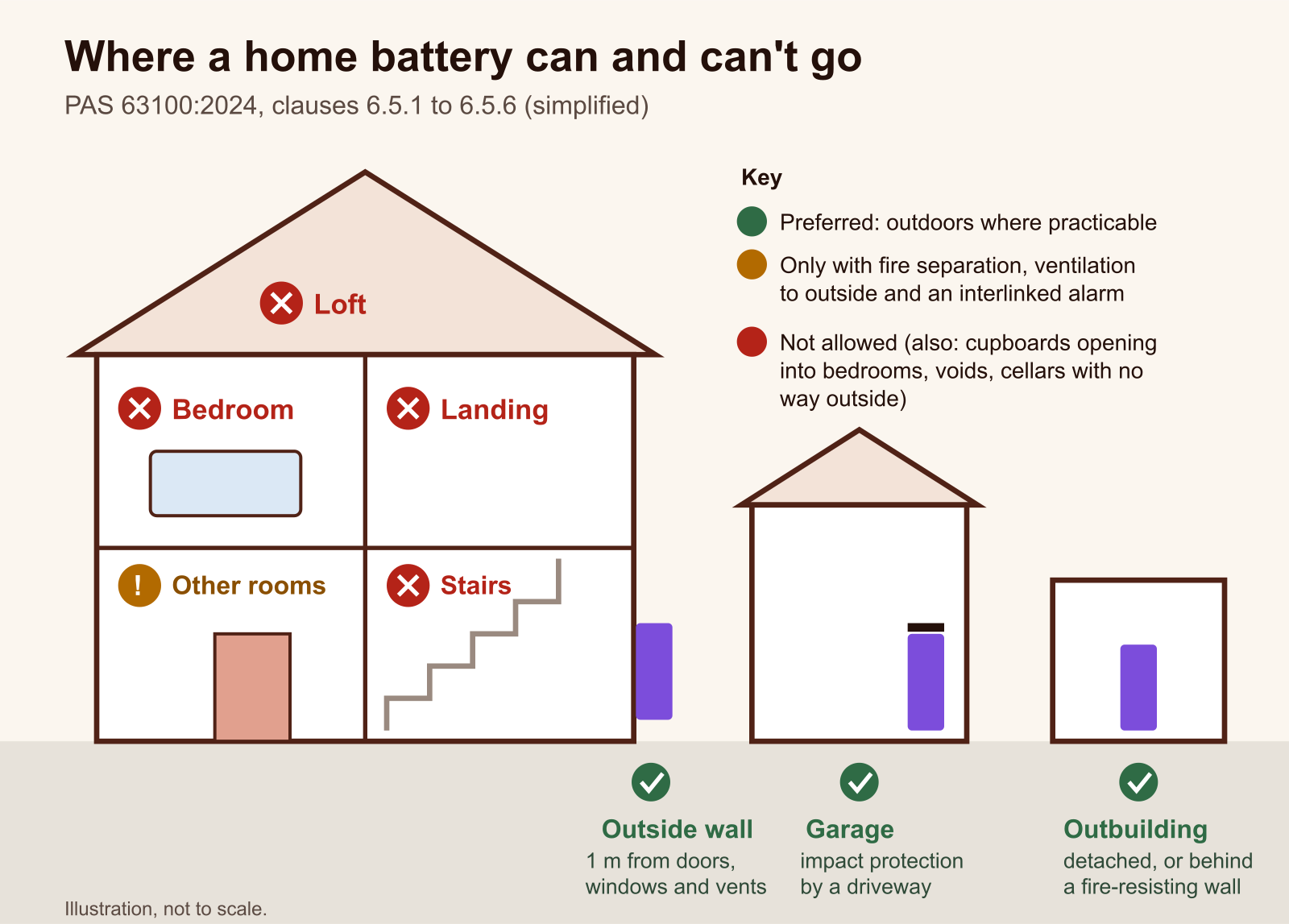
Once a location is chosen, the work to make it acceptable is what shows up on the quote:
| Item | Where it comes from | Usually needed when |
|---|---|---|
| Fire-resisting separation (REI 30) between an indoor battery and bedrooms or escape routes | PAS 63100 6.5.3 | Battery inside the house |
| Fresh-air ventilation to outdoors, ports at least 1 m from doors, windows and other vents | PAS 63100 6.5.4 | Battery inside the house |
| A smoke or multi-sensor alarm interlinked with the home's other alarms | PAS 63100 6.5.6 | Battery in a rarely visited spot, such as a store cupboard |
| Impact protection to IK10 | PAS 63100 6.6 | Garage, or beside a driveway |
| Fire-stopping where cables pass through an outside wall | PAS 63100 6.5.2 | Unit mounted on an external wall |
| A second enclosure | PAS 63100 6.1.3 (20 kWh per enclosure) | More than 20 kWh in total |
PAS 63100 is not law in itself and is reviewed at least every two years; DESNZ contracted an amendment and review in July 2026, so details may change. It covers homes of up to 200 m² floor area. It also notes that in certain cases a battery on an external wall could need planning consent or a building-control notification; if your home is listed or in a conservation area, check with the council before you agree a location.
The electrical items
Inverter work
Added to existing panels, a battery usually brings its own inverter (AC coupling) or replaces your solar inverter with a hybrid unit that runs both (DC coupling). Which?, citing the Energy Saving Trust, says AC systems tend to cost more, without figures. Either way, the inverter should be its own line. Our page on adding a battery to existing solar compares the two routes.
Backup in a power cut
A battery that keeps circuits running while the grid is down needs switching so that it can supply the home safely in isolation. PAS 63100 draws attention to the Electricity Safety, Quality and Continuity Regulations 2002 on switched and parallel sources. There is no official price for backup hardware, so ask what it covers (a few circuits or the whole home) and what it costs separately from the battery.
Protection and monitoring
Isolators, breakers and other protective devices for power flowing in both directions, plus setting up the monitoring app or control system, appear on most quotes. BS 7671, the Wiring Regulations, gained a chapter on stationary batteries in Amendment 4, published on 15 April 2026; the previous edition was withdrawn six months later. Ask which edition the installation certificate will be issued against.
Paperwork: the network operator and the certificates
Every battery has to be notified to the local network operator. MCS says storage up to 3.68 kW of inverter power can be notified within 28 days of installation under G98, while storage over 3.68 kW needs a G99 application before installation, as does most solar plus battery on one connection. We found no published fee for a home application, but it takes time and can come with conditions. Our network application guide covers both routes.
At handover you should get the electrical installation certificate under BS 7671, a statement of conformity with PAS 63100 attached to it, user instructions that include how to shut the system down and what to do in a battery fire, and the MCS certificate if the installer registers the battery with MCS. Battery storage is a separate MCS technology from solar panels, so check the installer's entry on the MCS register lists it.
Turning this into a quote you can compare
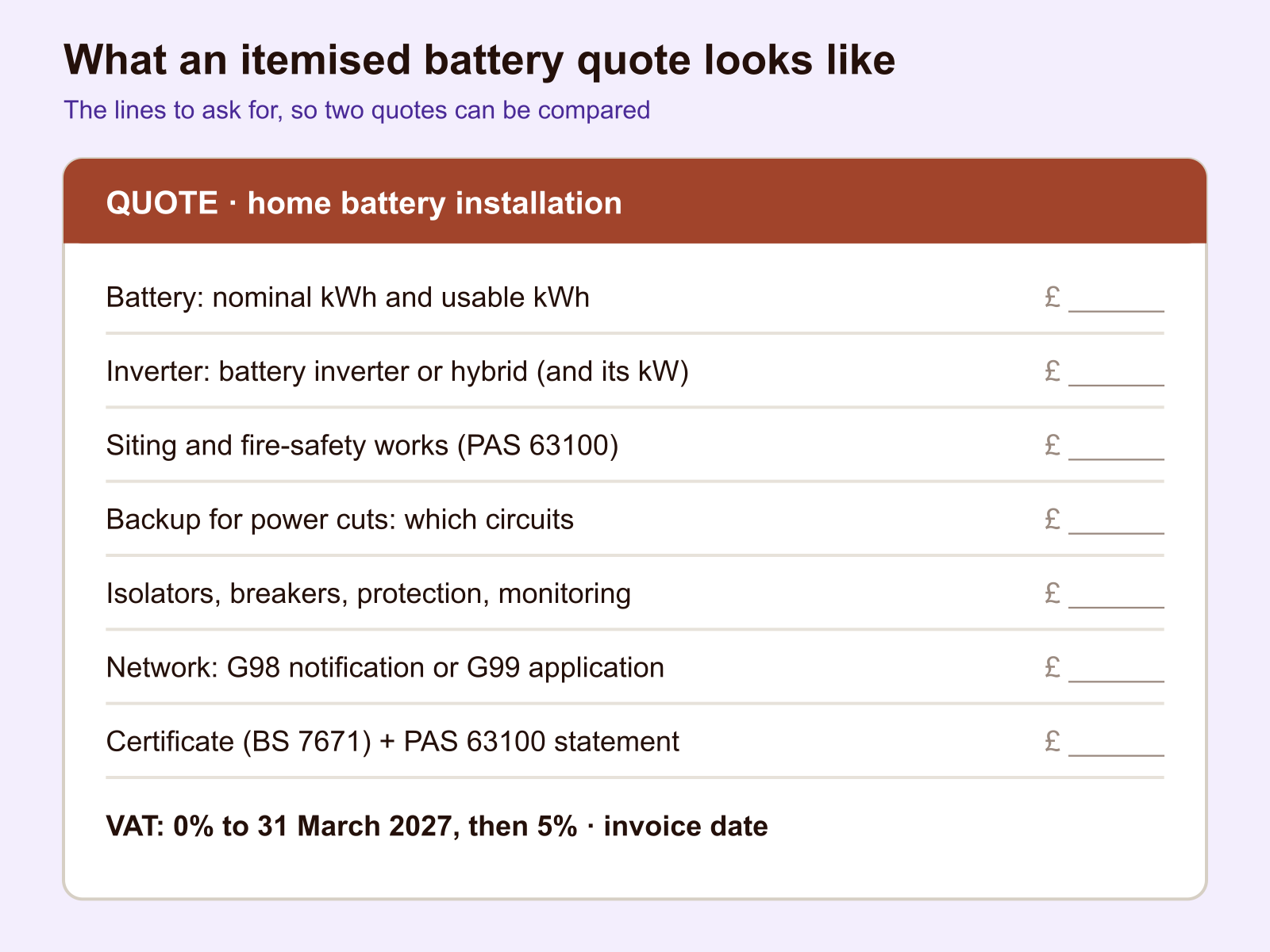
Send every installer the same short brief: the battery size you want priced (nominal and usable), where you would like it to go, whether you want backup and for which circuits, and whether you have panels already. Ask for a written, itemised quote with the battery, inverter, siting works, backup, protection, network application and certification as separate lines, and the invoice date they expect, because VAT moves from 0% to 5% on 1 April 2027.
Then compare the battery line with the official median using the quote checker, and go through our questions to ask before signing. A quote that won't itemise is harder to judge than one that is simply higher.
Sources (page last reviewed 3 November 2026)
- DESNZ: MCS certified domestic battery installation statistics (April 2024 to March 2026 workbook, published 28 May 2026), checked 3 November 2026.
- BSI / DESNZ: PAS 63100:2024, battery energy storage systems in dwellings (PDF), checked 3 November 2026.
- IET: Amendment 4 (2026) to BS 7671:2018 published 15 April 2026, checked 3 November 2026.
- MCS: notifying distribution network operators (G98 and G99), checked 3 November 2026.
- MCS: find an installer (the public register), checked 3 November 2026.
- DESNZ: Warm Homes Loan Scheme rules, version 3 (September 2026, PDF), sections 2.6 and 4.4 to 4.19, checked 3 November 2026.
- Which?: solar panel battery storage (secondary source, page updated 30 October 2026), checked 3 November 2026.
Want quotes to hold up against these figures?
Tell us the battery size you are pricing and your postcode. Your enquiry reaches SEO-DONS LTD, the company that publishes this price guide, and we reply by email. Sending it costs you nothing and commits you to nothing.
What happens next
- SEO-DONS LTD, the publisher of this price guide, receives your enquiry.
- We read what you sent and answer by email.
- You decide what, if anything, happens next.